
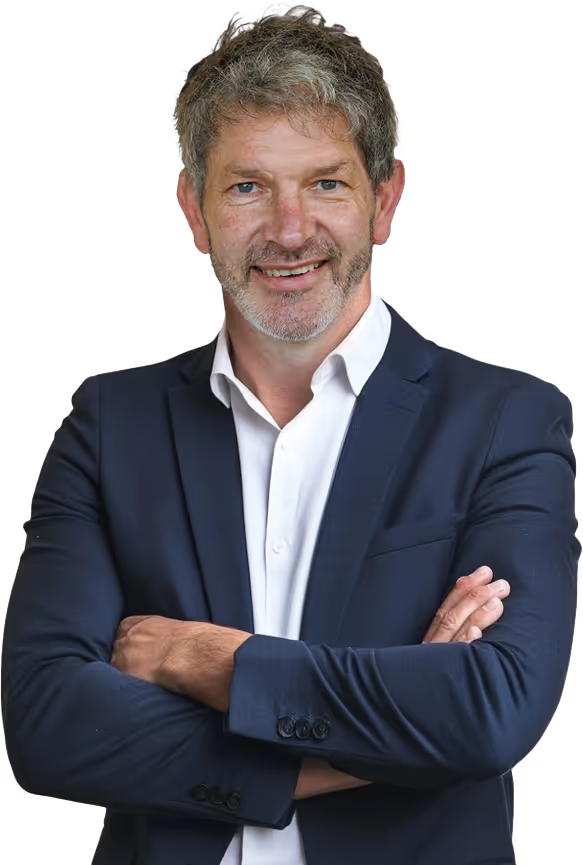
Hi, I'm Shane
By Shane Pearson, ICF Professional Certified Coach (PCC) | Nearly 20 years’ coaching experience
Feeling stuck in life is rarely as simple as not knowing what to do.
You may know something needs to change. You may even have a reasonable idea of what that change should be. Yet somehow you keep hesitating, procrastinating, going around in circles or slipping back into the same old patterns.
In nearly 20 years of coaching, I’ve found that people who feel stuck are rarely lacking ability, ambition or motivation. The five reasons I see most often are fear of change, lack of a clear and compelling vision, self-sabotage, overwhelm and a loss of self-trust.
Understanding why you are stuck matters, because different causes require different solutions. Here are five of the most common reasons I see - and five coaching strategies that can help you start moving again.
1. Part of you is afraid of what might happen if you change
Most meaningful change involves uncertainty.
Leave the job and you could regret it. Start the business and it might fail. Speak honestly and somebody might reject you. Make the wrong decision and you could lose something you already have.
So while one part of you may be imagining a better future, another is quietly asking: What if it all goes wrong?
That response is not necessarily evidence that the change is wrong. Fear and anxiety have a protective function, helping us respond to real or perceived threats. When the future is uncertain, possible negative outcomes can therefore command a lot of our attention. Research on fear and threat processing supports this protective role.
The life you have may be frustrating, but at least it is familiar. And familiarity can feel safer than possibility.
Coaching strategy: Focus on what you want - not what you’re afraid might happen
Fear naturally pulls your attention towards the future you don’t want, so deliberately give your mind something different to orient towards.
Ask yourself:
If fear wasn’t making this decision, what would I want?
If I trusted myself to handle whatever happened, what would I choose?
What would become possible if I moved towards that?
Then notice what happens when your mind begins predicting everything that could go wrong.
Ask:
Is this a real risk I need to respond to - or am I rehearsing a future I don’t want?
Real risks deserve consideration. Plan for them, reduce them where possible and make sensible decisions. But imagined possibilities do not automatically deserve control over your life.
Another useful question is:
What am I giving my attention to right now - what I want to create, or what I’m afraid might happen?
The aim isn’t to eliminate fear. It is to stop allowing fear to choose your destination.
2. You’ve lost touch with what you really want
Sometimes the problem isn’t being afraid to move. It is not knowing where to move towards.
You may be very clear about what you don’t want: you don’t want to feel like this anymore, you don’t want this job, you can’t continue at this pace, something has to change.
But away from here is not a destination.
When someone tells me, “I don’t know what I want in life anymore,” I rarely assume there is simply nothing there. Usually there is a story behind it.
Perhaps you became very good at doing what was expected of you. Responsibility gradually replaced possibility. You stopped wanting things that seemed unrealistic, spent years prioritising other people’s needs, or learned somewhere along the way that it was safer not to expect too much.
Eventually, I don’t know what I want can sometimes mean I’ve stopped listening to the part of me that knows.
Coaching strategy: Create a clear and compelling vision of the future you want
A compelling vision gives you something to move towards, rather than simply something to escape from.
Think of it as your North Star. It gives you something to orient yourself towards when fear, distraction or other people’s expectations pull you off course.
Or think about entering a destination into Google Maps. Until you know where you want to go, it is difficult to decide which roads to take, which turns matter or whether you are heading in the right direction.
And your vision needs to be more than sensible. It should have enough emotional pull that some part of you says: Yes. I want that.
“If you're not being defined by a vision of the future, then you're left with the memories of your past.” - Dr Joe Dispenza
Ask yourself:
If I could design the next chapter of my life rather than simply react to the one I have, what would I create?
What would make me genuinely excited about my future again?
What have I stopped allowing myself to want because it seems unrealistic, selfish or too difficult?
What would my life look like if I were living at my optimal level of wellness?
You don’t need to create a perfect five-year plan. You simply need enough clarity to begin recognising the direction that feels right.
A goal can tell you what to do. A compelling vision reminds you why you want to move at all.
3. You keep sabotaging your own efforts
This can be one of the most frustrating forms of stuckness.
You decide to change, make a plan and start well. Then something happens. You procrastinate, abandon the routine, relapse into an old behaviour or somehow find yourself doing almost anything except the thing you said mattered.
This is often the point where people say: “I know what I need to do, so why don’t I do it?”
We often call it self-sabotage, and our instinct is usually to attack it: Why do I keep doing this to myself? Why can’t I just have more discipline?
But behaviour that seems irrational often makes more sense when you understand what it is doing for you.
Avoidance might protect you from failure. Perfectionism might protect you from criticism. Procrastination might delay the moment your ability can actually be judged. An old habit might provide comfort, relief, certainty, belonging or escape.
That does not mean the behaviour is useful. It means fighting yourself may not be the best way to change it.
Coaching strategy: Understand what your self-sabotage is trying to do for you
Instead of immediately trying to overpower the behaviour, become curious about it.
Ask:
What is the positive intention behind this behaviour?
What is this behaviour trying to do for me?
What feeling does it help me avoid?
What does this part of me need?
How could I meet that need without sacrificing the change I want?
This is what I call the Resistance Reframe.
Instead of seeing the resistant part of you as the enemy, assume it has a reason for doing what it does. Often, it is trying to help or protect you using an old strategy that no longer serves you particularly well.
Once you understand its purpose, you can stop asking, How do I force myself to stop doing this? and start asking:
How can I get this part of me on side for the change?
That shift can turn an internal battle into a much more useful conversation.
4. You’re too overwhelmed to make the change stick
Sometimes you know exactly what needs to change and genuinely want to change it, but your current reality is that you are already stressed, overloaded or exhausted.
Change requires something from us. It takes attention, energy and consistency to interrupt established patterns, make a different choice and repeat that choice often enough for it to become more natural.
Our existing habits have an advantage: they are familiar. They require less conscious thought and can become the path of least resistance.
Research suggests that stress can, in some circumstances, make flexible goal-directed behaviour more difficult and bias us towards more habitual responses, although this is not a universal effect in every situation. A review by Schwabe and Wolf explores this relationship between stress and habit behaviour.
That fits what many of us recognise from real life. When you are overwhelmed, tired or under sustained pressure, it becomes easier to default to what you already do. You stay up too late even though you need sleep. Exercise disappears. You eat whatever is easiest. You scroll because you need relief. The things that normally energise you are often the first things to go.
Then your best-intentioned self arrives with another list of everything you should be doing.
The result can become a frustrating cycle:
Try harder → run out of capacity → fall back into old habits → criticise yourself → try harder again.
The problem may not be motivation. You may simply be trying to build change on a foundation that cannot currently support it.
Coaching strategy: Build your capacity for change first
If you are already overwhelmed, the first goal may not be reinvention. It may be to stabilise, restore some energy and regain a sense of control.
I often look for what I call the low-hanging fruit:
Where could you create the biggest improvement with the smallest realistic effort?
Maybe it is going to bed half an hour earlier, getting outside every day, restarting one form of exercise you know helps, eating one decent meal, stopping one unnecessary commitment or asking somebody for help.
Ask yourself:
What is draining the most energy from me right now?
What am I doing that makes life harder than it needs to be?
What have I stopped doing that I know helps me feel more like myself?
Where is the low-hanging fruit - the biggest gain for the smallest effort?
What is one change I could keep doing even during a difficult week?
This is also where self-compassion matters. Stop comparing yourself with an imaginary version of you who has unlimited time, energy and discipline. Start with the person who is actually here today.
Lasting change rarely comes from one heroic burst of motivation.
Everything you’re looking for may be on the other side of consistency - but consistency becomes much easier when you first build the capacity to sustain it.
If stress and overwhelm are making it difficult to think clearly, you may also find this simple breathing exercise for stress and overwhelm useful.
5. You have stopped trusting yourself
Another common form of stuckness begins with doubt.
You have an idea, then question it. You make a decision, then reconsider it. You ask somebody else’s opinion, then another person’s. You research, analyse and compare until somehow the more information you have, the less certain you become.
Eventually you don’t just doubt the decision. You begin to doubt yourself.
Low self-trust can show up as overthinking, procrastination, reassurance-seeking, negative self-talk and repeatedly outsourcing decisions to other people.
It can also become self-reinforcing. If you don’t trust yourself to make a good decision, you avoid acting. Because you don’t act, you generate very little new evidence that you are capable. And because there is no new evidence, your confidence remains low.
This is closely related to self-efficacy: our belief in our ability to take the actions required to influence an outcome. Research across behaviour-change settings supports the importance of self-efficacy, while also showing that it develops through experience rather than positive thinking alone. This systematic review explores self-efficacy in behaviour change.
Coaching strategy: Rebuild self-trust, brick by brick
Self-trust isn’t rebuilt through one big decision or by repeatedly telling yourself to be more confident.
Think of it like building a house. You don’t build the whole thing at once. You lay one brick, then another, then another. Eventually those small pieces of evidence become something solid enough to stand on.
Start by backing yourself again.
Not necessarily with decisions that could change your entire life. Start smaller. Make a considered decision and commit to acting on it. Follow through on something you said you would do. Keep a small promise to yourself. Choose what you think is right without immediately asking three other people to validate it.
Each time you do this, you provide yourself with another piece of evidence:
I can make decisions. I can trust my judgement. I can follow through. And if something doesn’t work out, I can deal with what happens next.
Then pay attention to the voice accompanying you.
Most of us have an inner critic that is remarkably skilled at spotting what went wrong, questioning our decisions and reminding us of previous mistakes.
You don’t need to silence that voice. You need to transform the inner critic into an inner coach.
An inner coach does not pretend everything went brilliantly when it didn’t. It acknowledges mistakes and setbacks, but asks better questions.
Instead of How could I have been so stupid?, ask:
What can I learn from this?
Instead of There I go again. I never follow through, ask:
What got in the way, and what could I do differently next time?
And remember to reinforce what is working too:
Where did I back myself today?
What did I follow through on?
What decision am I pleased I made?
What did I handle better than I might have in the past?
What does that tell me about who I am becoming?
You are gradually changing the story you tell yourself about yourself - not through empty affirmations, but through experience.
Make decisions. Back yourself. Follow through where you can. Learn when things don’t work. Acknowledge when they do.
Then lay the next brick.
Confidence grows when you repeatedly show yourself that you are someone you can rely on.
Getting unstuck starts with understanding what is keeping you stuck
If you feel stuck in life, the answer isn’t automatically to push harder.
You may need to address fear. You may need a clearer direction. You may need to understand your self-sabotage. You may need to rebuild your capacity. Or you may need to restore trust in yourself.
Often, several are operating at the same time.
So instead of only asking:
How do I make myself move forward?
Try asking:
What is actually keeping me where I am?
Once you understand that, you can start working with the real problem instead of repeatedly trying to solve the wrong one.
And you don’t need your whole life figured out before you begin. Sometimes getting unstuck starts with something much smaller: seeing your situation differently, making one decision you trust, and taking the next step towards the life you genuinely want.
Frequently asked questions
Why do I feel stuck in life?
Feeling stuck often happens when you want something to change but fear, lack of direction, self-sabotage, overwhelm or low self-trust makes moving forward difficult. Understanding which of these is operating can be more useful than simply trying to motivate yourself harder.
How do I get unstuck when I don’t know what I want?
Start by exploring what is no longer working and reconnecting with what matters to you. Consider what you want more and less of, what you are tolerating, what you feel you should want, and what you might choose if fear or other people’s expectations were less influential.
Clarity often develops through exploration rather than arriving fully formed.
Why do I know what I need to do but still don’t do it?
Knowing what to do does not guarantee that you have the emotional capacity, confidence or internal agreement to do it. Fear, overwhelm, established habits and self-sabotage can all create a gap between knowing and doing.
Rather than simply demanding more discipline from yourself, try to understand what is making the current behaviour easier, safer or more rewarding than the change.
Can coaching help if I feel stuck?
Coaching can help you understand what is maintaining the stuckness, clarify what you genuinely want, recognise patterns or beliefs that may be getting in the way and turn insight into practical action.
The aim isn’t for a coach to tell you what to do. It is to help you think more clearly, trust your own decisions and move forward in a way that is right for you.