


Hi, I'm Shane
The Road to Burnout
Where you are on the burnout–resilience continuum matters. But the direction you're travelling may matter even more.
“Am I burned out?”
It's a question people often ask when something doesn't feel quite right anymore. Perhaps you're more tired than you used to be, your motivation has dropped, work seems to take more out of you, or you're finding it harder to switch off and recover.
Maybe you just don't feel quite like yourself. You've lost some of your spark, your enthusiasm or what I often simply call your mojo.
But you're still functioning.
You're getting up, going to work, looking after other people and doing most of what needs to be done. So you wonder whether it can really be burnout. Perhaps you're just busy, stressed, going through a difficult patch or in need of a decent holiday.
And perhaps you are.
But having worked with many people experiencing stress and burnout at very different levels, I've come to believe there is another question that can be much more useful than trying to decide whether you've crossed some invisible line into burnout:
Which direction are you travelling?
Burnout rarely starts with burnout
At its more severe end, burnout can be debilitating. I've worked with people who became so physically and emotionally depleted that functioning normally became difficult. For some, getting through a normal working day was no longer possible; at the extreme end, burnout can leave someone spending much of their time in bed for days or even weeks.
That's not somewhere you want to end up!
The problem is that we rarely arrive there overnight. There is usually a road towards burnout, and when you're travelling along it slowly, it can be surprisingly difficult to recognise what's happening.
Your energy may gradually decline. You don't recover quite as quickly after a demanding week. Motivation becomes harder to find, things that once felt manageable require more effort, and you may become more irritable, withdrawn or less interested in things you normally enjoy.
None of these changes necessarily feels dramatic in isolation.
Instead, there can be a slow erosion of energy, motivation and wellbeing. What I often describe as gradually losing your mojo.
And because it happens slowly, we adapt. We get used to having less energy. We compensate by pushing harder. We tell ourselves we'll feel better after the weekend, after the holiday, when this project is finished or when life finally settles down.
Without really noticing it, a more depleted version of ourselves can start to feel normal.
That's why waiting until you can definitively answer “Yes, I am burned out” may mean waiting much longer than you need to.
The Road to Burnout
One of the ways I help people think about this is through a simple burnout–resilience continuum.
At one end is burnout: significant depletion, where prolonged stress may be affecting your energy, motivation, wellbeing and ability to function. At the other is resilience: greater capacity to meet life's demands, recover from stress and continue to function well.
Most of us aren't permanently located at either end. We move around the continuum as our circumstances, pressures, resources and capacity change.
But rather than trying to diagnose precisely where you sit, I find it more useful to ask two simple questions.
1. Where are you on the continuum?
2. Which direction are you travelling?
[The Road to Burnout™ graphic will be inserted here before publication.]
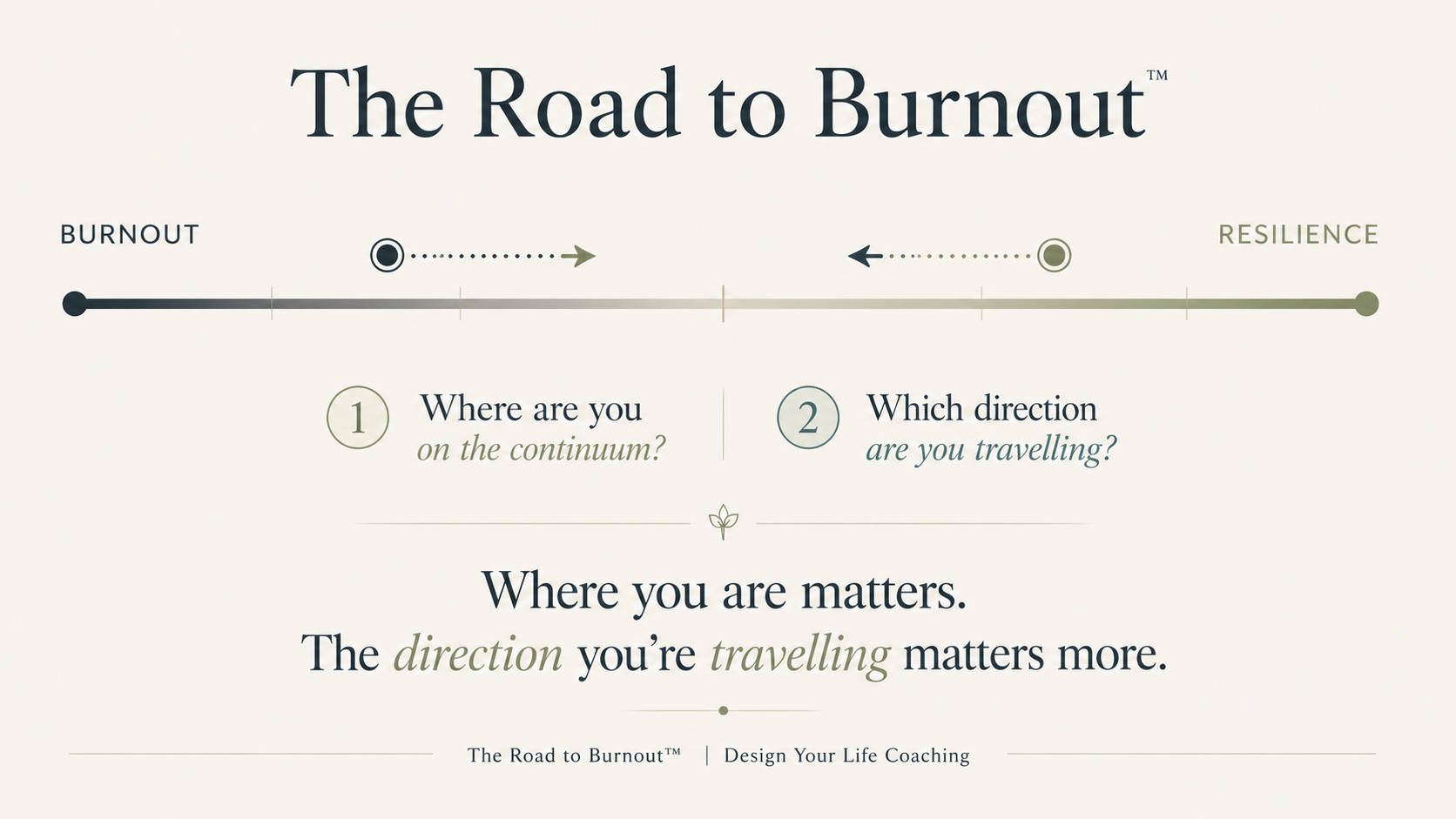
That second question changes how we look at burnout.
Why your direction may matter more than your position
Imagine two people.
The first is functioning pretty well. They have energy, they're getting their work done and, if you placed them on the continuum today, they might appear to be a long way from burnout.
But look at their trajectory over the past six months and something else becomes apparent. Their workload has steadily increased, sleep has deteriorated, exercise has disappeared, stress has become almost constant and they have progressively less energy left for life outside work.
They're not burned out.
But they're heading in that direction.
Now imagine someone else who is much more depleted. Perhaps they've already had a difficult period and, if we looked only at their current position, they would appear much closer to burnout.
But something has changed. They've recognised what's happening. Perhaps they've reached out for support, begun reducing some of the pressures they're under or simply made the decision that they cannot continue as they have been.
They may currently be in a worse place than the first person, but their direction of travel is different.
This is the distinction I think we often miss when we ask only, “Am I burned out?”
Where you are matters. The direction you're travelling matters more.
So, which direction are you travelling?
Rather than trying to decide whether you meet a particular definition of burnout, take a moment to look back over the past few months.
Think about your energy, motivation and general sense of wellbeing. Are you bouncing back reasonably well after stressful periods, or does the tiredness seem to be accumulating? Are things becoming easier to manage or requiring progressively more effort? Do you still feel engaged with your work, relationships and life, or have you gradually become more disconnected from them?
Perhaps the simplest question is this:
Compared with six months ago, do you feel more like yourself — or less?
You don't need to calculate a score, diagnose yourself or decide whether you're “burned out enough” to justify doing something about it.
Just notice the direction.
For some people, that can create a surprisingly important moment of recognition:
I'm heading the wrong way.
Recognising it may be the most important first step
If you've just recognised yourself in this, resist the temptation to immediately turn recovery into another project you have to succeed at.
You don't need a twelve-point plan. You don't need to overhaul your life tomorrow. And you don't necessarily need to know yet exactly what needs to change.
For now, the most important step is to acknowledge honestly that you're heading in a direction you don't want to continue travelling, then make a commitment to yourself that you are going to change direction.
That commitment doesn't magically remove the pressures you're dealing with. Nor does it mean recovering from significant burnout is simple. The more depleted you become, the harder it can be to find the energy, perspective and clarity needed to work out what needs to happen next.
But you don't need to have all the answers before deciding you don't want to keep heading towards burnout.
And you don't have to figure it out alone.
If you know something needs to change
If you've realised you're heading in the wrong direction but aren't quite sure how to begin turning things around, that's okay.
Sometimes the next step is simply to talk to someone who gets it.
I've spent many years helping people navigate stress, burnout and periods when life simply isn't working as well as it should. A conversation can give you space to step back, make sense of what's happening and begin to see what changing direction might look like for you.
If that would be useful, you're welcome to book a free discovery call with me. There's no need to have everything figured out beforehand. That's what the conversation is for.

